You cannot verify what you do not understand.
Engineering knowledge lives in documents. The geometry of a drawing, the formulas in a calculation sheet, the clauses of a standard, the signature on a permit. But those documents are not data. Hundreds of sheets are turned by human eyes, table is compared against table with a calculator, and approvals are issued on top of decades-old spreadsheets that nobody can audit. The problem is not the absence of AI — it is the absence of software that reads documents in the grammar of engineering.
doAZ compiles that grammar into code. How each design office annotates elevations on an earth-retaining drawing; the difference between ‘gross floor area’ and ‘floor area used for FAR calculation’ in a design summary; the character conventions of an instrument tag; the 60-day statutory clock in the Subcontracting Act; KS tolerances for a concrete mix. We deploy AI only as far as we have turned a site reviewer's tacit knowledge into deterministic rules. Arithmetic and determinations are owned by the deterministic engine; the LLM only proposes candidates, and never writes a coordinate or a number.
That is why doAZ's AI does not make the call. The engineer decides, and the AI shows every piece of evidence. Every value is traceable to page, cell, and coordinate — press a number and the drawing opens at exactly that spot. Results the system is not confident about are never quietly passed through; they surface as pending review. Never turning ‘unknown’ into ‘pass’ — Zero Silent Error — is not a matter of culture. It is a contract enforced by code and tests.
Industrial Knowledge to Actionable AI. Understand. Compile. Verify. Operate.
This principle came out of the field, not a laboratory — review automation here was designed by someone who spent 16 years watching how review fails on EPC sites in 19 countries.Founder Youngtae Kim · U.S. licensed Professional Engineer (PE)
Five places where a general-purpose VLM fails on drawings
Structural limits of foundation models, measured on our own benchmark (AEC-Bench) — and the reason doAZ's technical moat is defensible.
Cannot follow detail references from one drawing to another
Relationships that span multiple sheets
Notation conventions that differ from office to office
Identifying exactly what a leader line points at
Tracing how an R2→R3 change ripples through the set
Plausible wrong answers cannot be controlled — the most dangerous failure mode
No domain depth — unaware of the 888 sections of KDS/KCS (Korean Design/Construction Standards) or the grammar of a drawing
Knowledge never accumulates — everything resets when the project ends
Why there is no guesswork — the deterministic engine owns the numbers, and AI finds and explains the evidence.
Numbers are always owned by the data and the calculation engine. The LLM only proposes where to look, and explains why.
Five layers, separated by role — leaving no room for guesswork
A deterministic parser owns all vector PDF and CAD geometry, down to coordinate-level traceability. VLMs are used only for scanned drawings — a dual-track design in which the two tracks cross-check each other.
Every calculation is executed by a deterministic engine. The LLM is never involved in the arithmetic — the LLM never does math.
Design standards and statutes are converted into executable, reproducible rules. The same input always yields the same determination.
Every answer is required to carry a document and page citation. An answer without a source cannot structurally exist.
When the evidence is weak, the model abstains and hands the item to a human reviewer. Saying that you do not know is where trust begins.
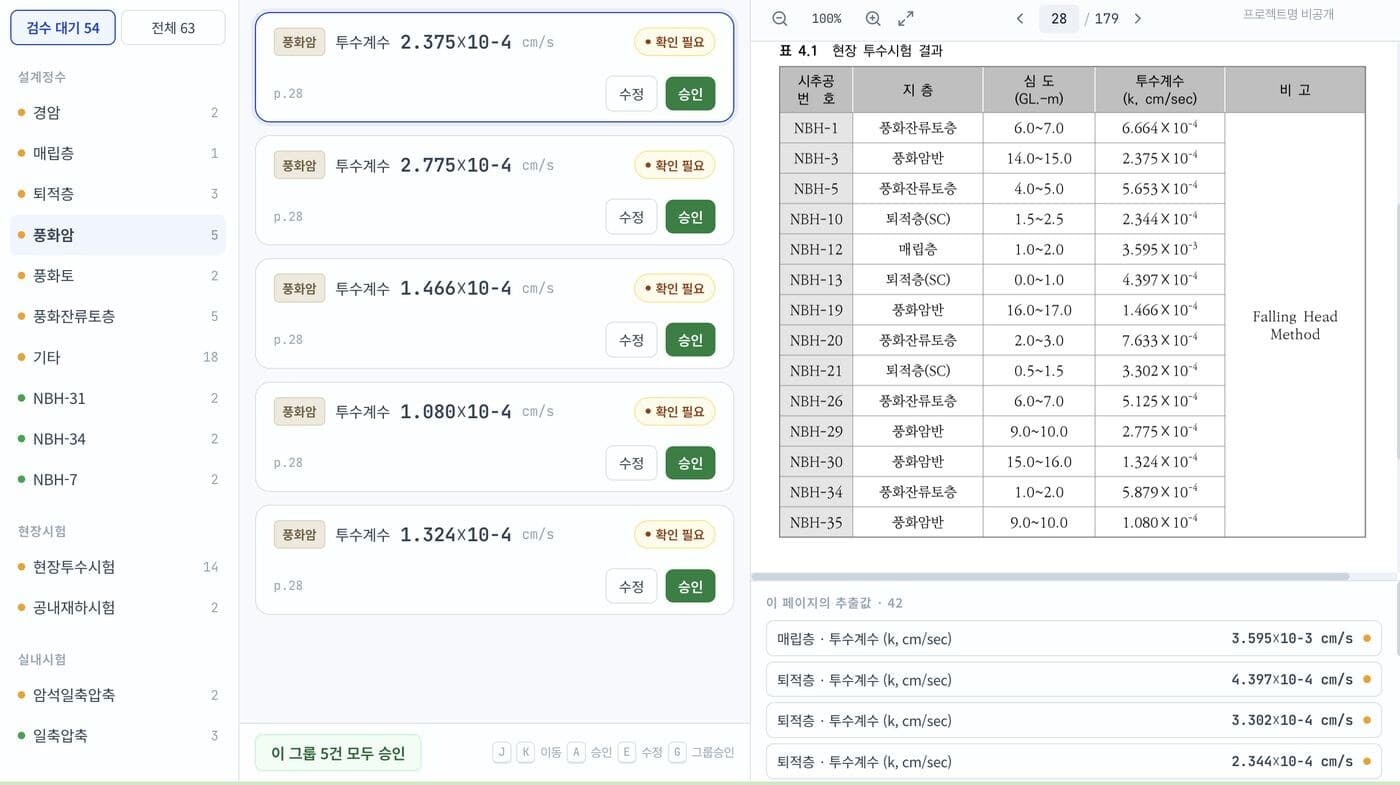
HITL Review Cockpit — the AI drafts, a person decides
Every determination arrives with its source location, the governing clause, the calculation, a confidence level, and the accountable reviewer. Whether the reviewer can actually sign off is the design criterion for every screen.
Three-way cross-verification, with the drawing as the axis
The drawing is the reference point for every other document. doAZ puts the drawing at the center and has machines verify consistency between documents — extending all the way to document ↔ document.
16 window marks on the floor plan against 11 entries in the window schedule, reconciled one by one — LH apartment design verification.
Plant Spec ↔ BM ↔ ISO 3-way consistency across 470 standard documents — Coway Entech.
Design documents cross-verified against field instrumentation, with displacement prediction — POSCO E&C, 99.2%.
Subcontracting Act risk cross-referenced across contracts, written requests, and email — Doosan group PoC.
The ladder to L4 — and why this ladder is honest
Confidence tiers, abstain, HITL, recheck — stating the limits of each stage and disclosing the scope of what was verified is a doAZ principle.
Dual-track: deterministic parser for vector, VLM for scans only
Drawing ↔ drawing · drawing ↔ document · drawing ↔ reality
HITL Review Cockpit — evidence, confidence, audit log
The goal: the world's leading Engineering AX
Four moats
15,000+ industrial working documents structured
16 years of EPC field experience by the founder, plus a U.S. PE license
KDS/KCS, IMO, and statutory codes compiled into rule assets
16 enterprise references that are themselves a barrier to entry
On-premise · air-gapped
We serve open-weight models ourselves, so data never leaves your perimeter. The stack was designed to be 100% open source on the assumption that it must pass into nuclear and public-sector air-gapped networks, and we operate it on our own GPU infrastructure.
We will show you the engine actually running
We run a technical verification demo on one real set of your own drawings.
Request a verification demo