What doAZ actually catches — with the evidence attached
Below are determinations the doAZ verification modules produced on a public demo project. Every finding carries drawing coordinates, the governing clause, and a confidence level — and when the evidence is weak, the system declares a hold before anyone has to ask.
Every determination is anchored to a coordinate on the drawing
A finding is never just a sentence. It resolves into one of four verdicts, each one attached to the position on the drawing that produced it — so a reviewer can go straight to the evidence instead of searching for it.
Two sources disagree and the evidence is strong enough to say so — a symbol drawn on the plan with no matching schedule entry, for example.
The sources conflict and neither side can be proven right. The decision goes to a reviewer instead of the system choosing the plausible one.
Both sides agree at symbol level. The agreement is recorded together with the evidence coordinates on the drawing.
The evidence is too weak or the source is unreadable, so the system declines to answer and surfaces the original page instead.
An interactive click-through of these verdicts on a synthetic drawing is available on the Korean version of this page.
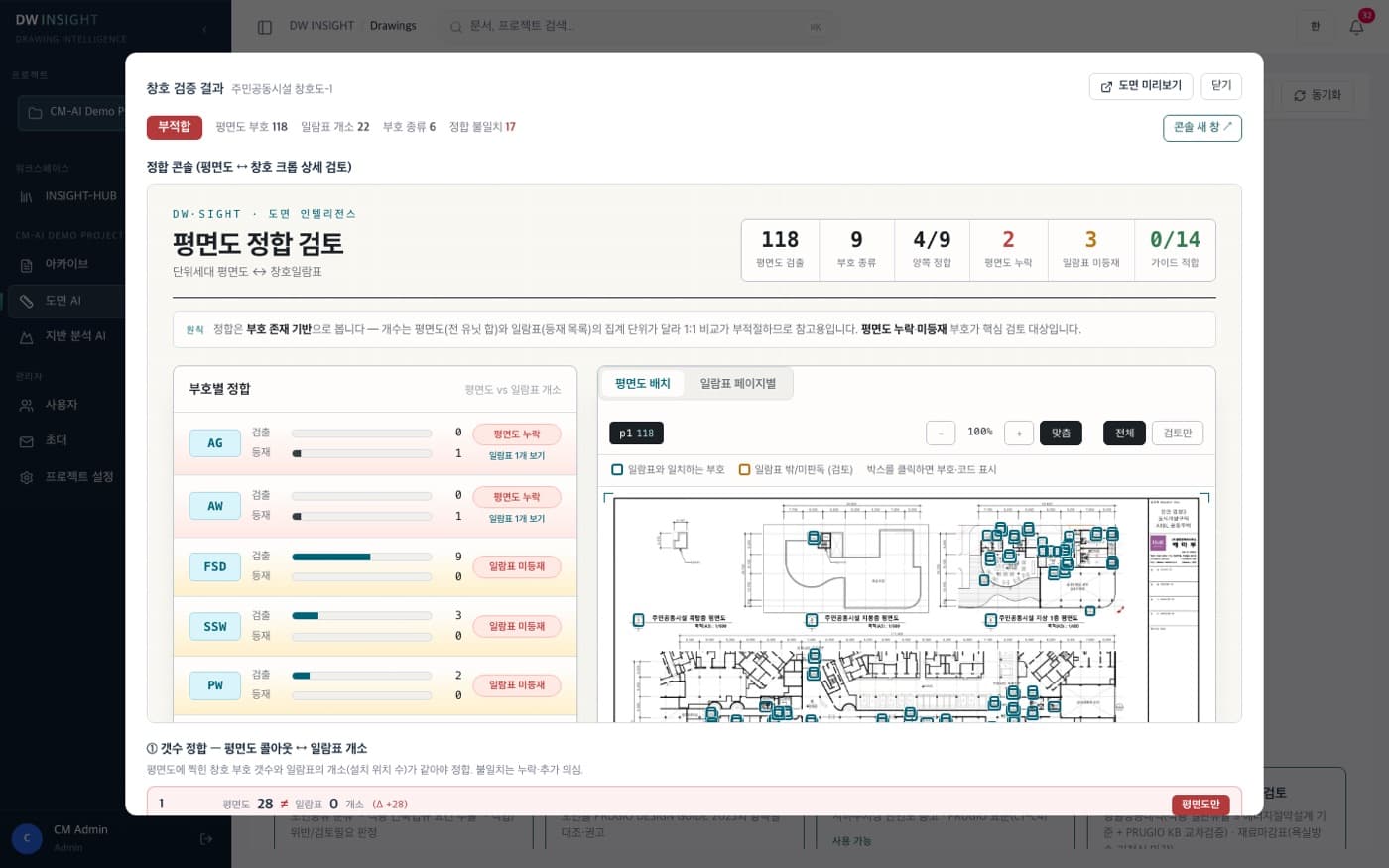
Three symbol types missing from the schedule — drawn on the plan, absent from the order list
Three of the symbol types detected on the unit-plan drawings were never registered in the window & door schedule. This is the pattern that turns into a missed procurement order on site — precisely the kind of error a sampling-based review does not catch.
Two symbol types missing from the plans — listed in the schedule, gone from the drawing
Two symbol types registered in the schedule were not detected on any plan. This is the revision-propagation pattern: the symbol was removed during a drawing revision (R2 to R3) while the schedule entry survived untouched.
Floor-height label contradicts the dimension ladder — escalated to REVIEW
The floor-height label on the section drawing did not agree with the sum of the dimension ladder. Instead of picking whichever value looks more plausible, the system escalates the case to REVIEW — zero false-confident determinations is the design goal.
Design review comments — all thirteen items traced end to end
Building committee review comments and the corresponding action plan are parsed automatically, matched one-to-one against the drawing registry, and each item is judged as reflected, partially reflected, or not reflected. On a live project, 13 of 13 items were confirmed as reflected.
Unreadable spans — reported, never guessed
Where the text encoding of the source PDF was corrupted, the system did not estimate a value. It states plainly that the chunk is unreadable and points the reviewer to the original page — an honest hold instead of a plausible wrong answer.
The same discipline, measured on customer projects
Geotechnical review — where drawings meet reality
POSCO E&C · joint commercialization
basis: POSCO E&C frozen gold set
case detail →Every review comment linked to its drawing
Daewoo E&C · DW-SIGHT
basis: 13 of 13 items on a live project
case detail →Every answer carries document, page, and quote
Lotte E&C · commercial deployment
basis: measured in the Lotte E&C production environment
case detail →What would we find in your drawings?
A technical verification demo starts with one real set of drawings — we agree on the accuracy definition against a frozen gold set, then measure it.
Request a verification demo